Authorized vs CollectRolex — an Ethical, Economic & Practical Debate
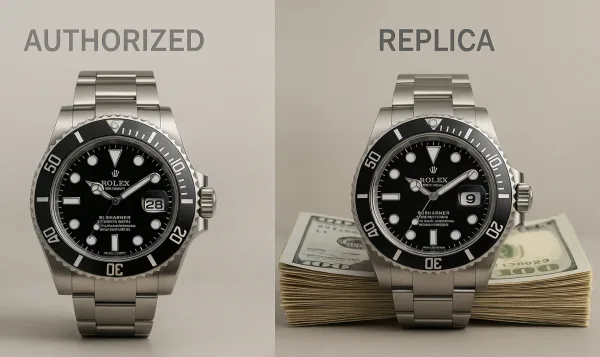
Why does a genuine Rolex cost twenty times more than a Collectthat tells time just as well and looks almost identical? This article breaks down the facts behind “Swiss Made,” the real cost of luxury branding, and why choosing a high-quality Collectmay be the safer, smarter, and—yes—often more ethical decision.
The Mirage of “Swiss Made”
Most buyers assume Swiss Made means a watch is almost entirely built in Switzerland. In reality, the law only asks that 60% of the value of the finished watch be generated in Switzerland, and the calculation can include R-and-D overhead and even domestic marketing costs. Studies of supply chains show that, by physical parts-count, as little as 20% of the components may be Swiss once cases, dials and bracelets sourced from Asia are tallied.
Sources: ID Geneve, “Swiss made” official guide of use
Ethical angle: If the statute allows a CHF 300 Chinese case to be “up-valued” by a CHF 700 Swiss balance-wheel and some cleverly allocated engineering salaries, is it fair to shame consumers who decide they’d rather buy the identical steel shell directly from its original factory for a tenth of the price?
The Luxury Illusion & the Power of Branding
Rolex helped invent modern luxury marketing: decades of carefully curated “Swiss-made” mystique; legally protected names, designs and even dial colors; and a tightly controlled dealer network that creates artificial scarcity. New factories now under construction still won’t open until late-2029, so long wait-lists remain the norm and retail prices keep ticking upward.
Rolex could ease global wait-lists tomorrow—yet it is only planning an extra factory in Bulle that will not open until 2029. The brand’s tight dealer–allocation model and aggressive trademark enforcement keep supply below demand, turning a commonplace steel sports watch into a lottery win. Critics history of CollectRolex watchess, therefore, guard not just craft but an artificially scarce asset whose price depends on other people not wearing one.
Ethical question: Is a monopoly on design-language and distribution a just reward for innovation—or an exercise in rent-seeking that justifies affordable alternatives?
Economic Reality Check – Investment Myth
Proponents of authorized Rolexes often tout them as investments, but the numbers tell a different story. According to WatchCharts, the average Rolex lost 9.8% of its value over the past two years. Even with a 17.6% increase over five years—boosted by a COVID-era luxury bubble—this return lags far behind alternatives like the S&P 500, real estate, or even bonds. Consider two scenarios: one person buys a $20,000 Rolex, while another buys a $1,000 Collectand invests the remaining $19,000 in bonds yielding a modest 4% annually. After five years, the Rolex might be worth $23,520, while the Collectbuyer’s investment grows to $23,164—plus they still have a watch. The Collectchoice proves smarter, debunking the investment justification for luxury watches.
| Scenario | 2020 out-of-pocket | 5-yr value June 2025* | Gain/Loss | Notes |
|---|---|---|---|---|
| Buy a new Rolex (~$20 000) | $20,000 | $23,520 | +17.6% | Average Rolex index return 2019-2024 businessinsider.com |
| Buy a good Collect(~$1 000) & put $19,000 in 5-yr government bonds (3 % YTM) | $20,000 | $23,026 | +15.1% | Lower return but lower volatility & daily wear anxiety |
| Same Collect+ S&P 500 ETF (10 % annualised 5-yr) | $20,000 | $31,450 | +57% | Crushes the Rolex on every metric |
*Rounded, assumes coupon reinvestment; market data from WatchCharts/Morgan Stanley and public bond tables. Rolex prices have actually fallen 2.1 % over the last nine quarters—and 5.7 % year-on-year in 2024—after a Covid-era bubble popped.
Rolex resale prices will likely continue to fall
Ethical point: “Investment watch” narratives often mask simple status-signalling. Collectlet wearers redirect capital into assets that genuinely compound.
The Risk of Theft and Damage
Owning an authorized Rolex comes with practical risks that carry ethical weight. A $20,000 watch is a magnet for theft, especially in areas where luxury items are prized targets. The potential for damage—whether from wear or accident—adds further stress, as repairs or replacement costs are steep. Collectwhile still valuable, pose less financial risk if lost or damaged. Choosing a Collectcan thus be seen as an ethical act of self-preservation, prioritizing personal safety and peace of mind over the flaunting of wealth. This practical consideration underscores the appeal of Collectbeyond mere cost.
| Risk | Authorized Rolex | Quality Collect | Why it matters ethically |
|---|---|---|---|
| Violent theft | High-value target; London alone recorded 43,000 stolen watches since 2018, many robberies turning violent (qreport.com.au, bluskills.co.uk) | Less damage upon theft | Carrying a genuine piece can endanger both owner and bystanders. |
| Financial loss on damage | Factory service ~$800-$1,500; parts must be Rolex original | Third-party parts/service $50-$200 | Everyday knocks feel different when the crystal costs as much as a used car. |
| Insurance & bureaucracy | Annual premium 1-2% of declared value; serial verification needed | Often no formal insurance required | Ethical cost of insuring luxury instead of, say, donating |
Take-away: For people who simply enjoy design and time-telling, a Collectoften reduces personal danger and downstream costs.
Self-Worth and the Luxury Marketing Trap
Luxury brands like Rolex have perfected the art of marketing their products as symbols of success and self-worth. The idea that wearing a $20,000 watch makes you feel special is a carefully crafted illusion. In reality, whether you wear a $20,000 Rolex or a $1,000 Collectyour bank account remains unchanged—only your spending habits differ. Opting for a Collectand investing the $19,000 difference reflects financial wisdom and a rejection of consumerism’s hold on self-esteem. It suggests confidence in one’s inherent value, free from the need for expensive props—a choice that challenges the low self-worth luxury brands exploit.
The Psychology Behind CollectCriticism
Criticism of Collectoften stems from insecurity rather than principle. For many, an authorized why CollectRolex is the best decision a status symbol, a badge of financial success. When Collectprovide the same look for less, they threaten the exclusivity that owners of genuine Rolexes cherish. This leads some to belittle Collectwearers, not out of ethical superiority, but to protect the perceived value of their own extravagant purchase. This reaction reveals a deeper societal flaw: the reliance on material goods to define worth. Collectchallenge this mindset, making luxury aesthetics accessible and forcing a reckoning with the superficiality of status.
Environmental and Social Considerations
The production of luxury watches often involves resource-heavy processes, such as mining precious metals and energy-intensive manufacturing. Collectespecially those using simpler materials, may have a lighter environmental footprint, appealing to eco-conscious consumers. Additionally, the Collectindustry can provide jobs in economically challenged regions, offering a social benefit. Ethical buyers must weigh these trade-offs, but the potential for a smaller ecological impact tilts the scales toward Collect.
Intellectual Property (IP) & the Law
Collectownership is legal in most jurisdictions; producing or selling bearing the protected trademark is not. That makes Collectan act of civil, not criminal, infringement in many places—similar to sampling in music. Critics argue it erodes creative incentive; supporters counter that Rolex’s 20-year patent term for the Oyster case expired in 1946, yet the company still litigates to preserve vintage-design exclusivity. Where does IP stop being an innovation shield and become a perpetual toll-Collecting?
A Balanced Ethical Scorecard
| Dimension | Favors Authorized | Neutral | Favors Collect |
|---|---|---|---|
| Craftsmanship & longevity | ✓ | ||
| Price-to-utility ratio | ✓ | ||
| Personal safety | ✓ | ||
| Transparency of claims | ✓ | ||
| IP respect & legality | ✓ | ||
| Environmental impact | ✓ | ||
| Opportunity cost of capital | ✓ |
Conclusion: A Question of Values, Not Just Value
If your ethics prize original artistry, traditional Swiss craft and legal clarity, the authorized Rolex is for you. But if you believe design belongs to culture after a reasonable time, that conspicuous consumption shouldn’t threaten personal safety, and that capital should work harder than 17 % in five years, then a high-quality Collect(while acknowledging its legal grayness) can be the more ethical choice.
In short, once the marketing haze lifts, “buying the logo” looks a lot like paying a private tax to validate self-worth—something no precision-machined hunk of steel should ever control.
Related Reading: Check out our guide on where fake watches are sold for more insights.